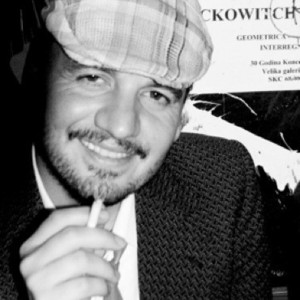
Driton Hajredini is a contemporary artist from Kosovo, born in Prishtina in 1970, where he also grew up. He studied at art academies in Kosovo and Germany and currently lives and works between the two countries. His artistic practice spans painting, video art, installation, photography, and film, exploring themes of identity, borders, refugees, migration, war, and isolation. Hajredini’s work is known for its critical, often ironic, and provocative approach to social, political, and cultural realities. He challenges artistic conventions and uses humor to comment on or parody well-known works of international art.
Hajredini has exhibited widely in solo and group exhibitions, biennials, and international art and film festivals. In 2003, he participated in In the Gorges of the Balkans in Kassel, Germany, curated by René Block, as well as the Instant Video Festival in Manosque, France. In 2004, his work was featured at the Total Museum of Contemporary Art in Seoul, e-flux Video Rental in New York, Somewhere in Prishtina in Graz, and the fifth Cetinje Biennial, Love It or Leave It, in Montenegro.
In the years that followed, his work appeared at the KunstFilmBiennale in Cologne, the European Media Art Festival in Osnabrück, MuseumsQuartier in Vienna, and e-flux Video Rental in Berlin, Amsterdam, and Miami. In 2006, he participated in art events at BA-CA Kunstforum in Vienna and as part of Manifesta 6 in Nicosia, Cyprus. In 2007, he took part in the Talent Campus at the Sarajevo Film Festival, as well as art programs at the Cité Internationale des Arts in Paris and De Appel in Amsterdam.
In 2009, Hajredini participated in Who Killed the Painting? at the Weserburg Museum in Bremen, the fourth Prague Biennale, and art events in Wiesbaden and Nuremberg, Germany. In 2022, he was part of Manifesta 14, the international contemporary art biennial held in Prishtina. In 2023, he received first prize at the Muslim Mulliqi exhibition organized by the National Gallery of Kosovo.
Working across different forms, Hajredini explores the relationship between individuals and the social and political structures that shape their lives, reflecting on experiences of displacement, belonging, and the lasting effects of conflict. His works often challenge traditional forms of artistic representation, using irony and cultural references to invite reflection on history, identity, and contemporary society.